LABOUR MARKET IMPACT ASSESSMENT (LMIA)
The application’s main purpose is to assess eligible Canadian business owners/employers who want to hire a temporary foreign worker (TFW). Therefore, they need to apply for LMIA under their businesses to sponsor the TFW’s work permit.
Once LMIA is approved, then the TFW can use this to apply for their work permit. The type of work permit received by using LMIA is called “LMIA-based Work Permit,” or “Closed Work Permit” because the TFW who has this work permit is only allowed to work for that particular company, and not anywhere else.
In some cases, if the TFW is eligible, then he or she may apply for a permanent residence application through a federal program called Express Entry, which will be covered in another section.
LMIA is assessed by a government body called Service Canada. The main intention of assessing the Canadian business is to ensure it actually has a need to hire the temporary foreign worker, has enough financial and organizational capacity to hire the foreign worker, and most importantly, the business has shown recruitment efforts to hire local Canadians and permanent residents first before giving an opportunity to a foreign worker.
As a result, the LMIA application is constituted of information requirements that will prove the business’s need for a TFW, its financial information, organizational structure, and recruitment efforts.
There are currently three main types of LMIAs:
Regular LMIA: This is filed under the High-Wage or Low-Wage stream. It can be used to support a work permit or a permanent residence application. The business may name a specific TFW, or file an unnamed LMIA and assign a name later. This LMIA typically supports a work permit for up to 1 year but the duration is subject to change with the regulatory changes.
Permanent Residence (PR) LMIA: This is filed under the Permanent Residence stream. It is used strictly to support an application for permanent residence and does not support a work permit. It requires a named foreign worker and is only available to businesses operating for more than one year.
Seasonal Agricultural Worker or Agricultural Stream LMIAs: These are separate streams designed for agricultural employers, and have their own advertising and wage requirements.
The “Owner-Operator LMIA” pathway was officially discontinued by Service Canada in April 2021. Business owners who wish to work in Canada must now apply under standard LMIA streams and meet all recruitment and job advertisement requirements, or consider LMIA-exempt options such as the C11 work permit under the International Mobility Program.
All LMIAs expire six months after the approval date. This means the employer must ensure that the foreign worker applies for their work permit or permanent residence within that six-month period.
Processing times vary based on the stream. As of May 2025:
High-Wage Stream: approximately 61 business days
Low-Wage Stream: approximately 74 business days
Permanent Residence Stream: approximately 214 business days
For each LMIA application, except the PR-only LMIA, the government fee of CAD $1,000 is charged by Service Canada.
Job advertisement and recruitment are required for all LMIA applications. This includes posting to the Government of Canada’s Job Bank and at least two other sources targeting underrepresented groups or sectors.
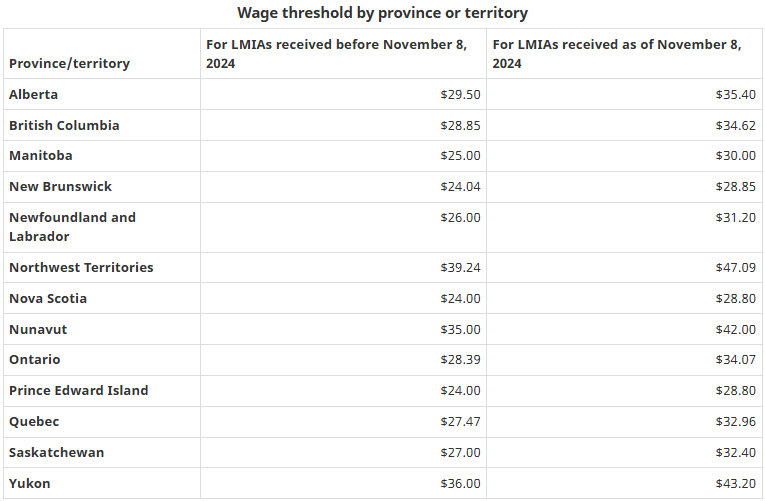
Each LMIA must be filed under either the High-Wage or Low-Wage stream, depending on whether the position’s hourly wage is above or below the median wage for that province or territory. The median wage thresholds are updated regularly by the government.